Whole-structure fumigation resolves widespread infestations of drywood termites that have penetrated beyond finished wall surfaces into structural load-bearing timbers. The process requires establishing an unbroken…
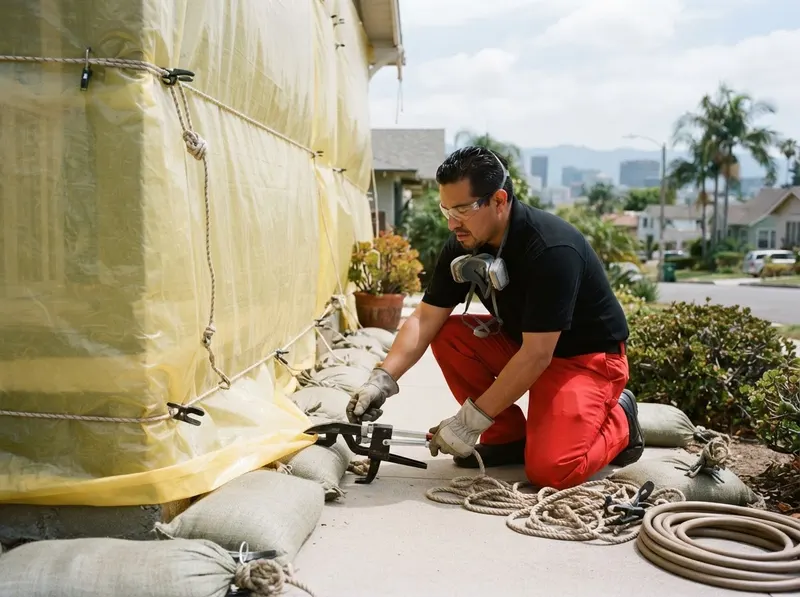
Whole-structure fumigation resolves widespread infestations of drywood termites that have penetrated beyond finished wall surfaces into structural load-bearing timbers. The process requires establishing an unbroken containment barrier over the building perimeter, documented under strict oversight by the California Structural Pest Control Board. In hillside neighborhoods like Silver Lake and Los Feliz, post-and-beam construction and exposed architectural rafter tails frequently conceal multiple drywood termite galleries that localized spot injections cannot reach. Fumigation saturates the entirety of the structural envelope simultaneously. When drywood termite fecal pellets (frass) drop across multiple rooms or high vaulted ceilings in Encino or Pacific Palisades, localized heat or localized liquid foams leave untreated voids; whole-structure containment ensures the gas penetrates dense Douglas fir and engineered joists to eradicate colonies in a single deployment.
Operational execution demands rigorous compliance with the California Department of Pesticide Regulation and local utility directives. Before sealing the envelope, property owners must coordinate with the Southern California Gas Company to physically shut off the exterior natural gas meter and disconnect interior pilot flames. The containment process uses heavy vinyl-coated nylon tarps secured along the perimeter with sand snakes to hold sulfuryl fluoride inside. Air quality standards during venting align with requirements monitored by the South Coast Air Quality Management District. For historic Spanish Colonial structures in Boyle Heights or mid-century perimeters in Sherman Oaks, clay tile roofs require careful walk-board installation to prevent structural tile fractures during the tenting phase.
Property clearance follows precise instrumentation checks to guarantee life safety before uncoupling secondary door locks. Technicians utilize low-ppm clearance devices certified according to the US Environmental Protection Agency registration standards and calibration guidelines verified by the National Institute of Standards and Technology. Gas levels must test at or below 1 part per million (ppm) before the property is cleared for human re-entry. In dense multi-family zones such as Koreatown or zero-lot-line properties near Venice canals, exterior boundary clearance offsets are maintained strictly according to municipal fire guidelines set by the Los Angeles Fire Department and Occupational Safety and Health Administration jobsite containment regulations. Structural owners facing extensive wood pest damage in Highland Park or Brentwood receive complete intake clearance records and interior remediation logs directly from CopperLine Pest Services. For questions on clearance documentation or to coordinate a perimeter assessment, call (424) 540-2745.
Every job gets a firm, written price after a free on-site visit.
For standards, safe disposal, and service guidance on pest control services in Los Angeles, CA, useful references include U.S. EPA, ENERGY STAR, U.S. Dept. of Energy, Consumer.gov, U.S. Census Bureau, and Google Maps. General consumer and small-business resources are available from USA.gov, Better Business Bureau, FTC Consumer Advice, U.S. Small Business Administration, and Ready.gov.
Tell us about your whole-structure fumigation job in Los Angeles and we'll send a clear, written quote, usually the same day.
 CopperLine Pest Services