Subterranean termite soil barrier defense applies a defensive chemical perimeter to stop California Department of Pesticide Regulation registered target species from tunneling into Los Angeles structures. In older…
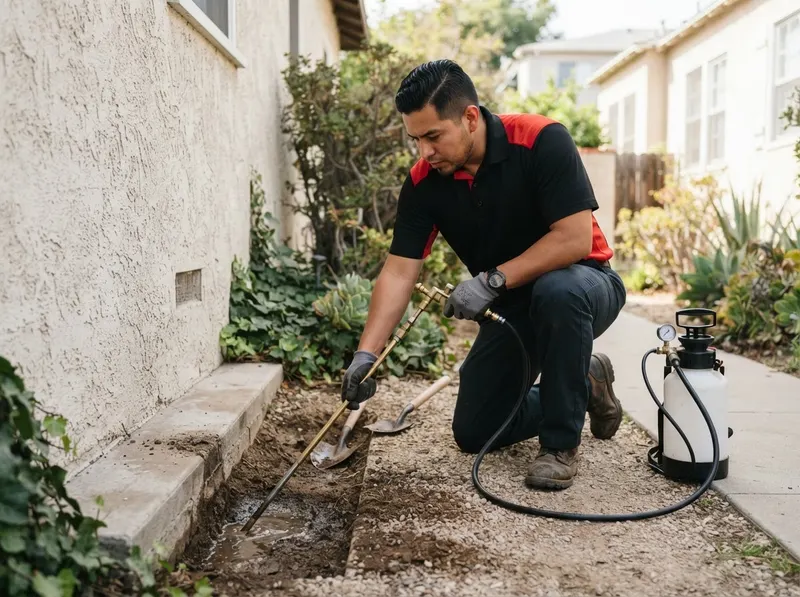
Subterranean termite soil barrier defense applies a defensive chemical perimeter to stop California Department of Pesticide Regulation registered target species from tunneling into Los Angeles structures. In older crawlspace properties throughout Silver Lake, Highland Park, and Los Feliz, unsealed raised foundations expose sub-floor framing directly to native moisture reservoirs. Technicians excavate continuous trenches measuring 6 inches by 6 inches against exterior stem walls, infusing the excavated earth at a rate of 4 gallons per 10 linear feet per foot of depth using solutions verified under EPA pesticide programs. Where flat concrete slabs abut soil, common across post-war mid-century tract foundations in Encino and Sherman Oaks, specialized rotary hammer drills bore 0.5-inch ports spaced every 12 inches to saturate soil directly beneath the foundation per standards set by the Structural Pest Control Board.
Unlike fumigation or whole-structure tenting designed exclusively for drywood termites (UC IPM guidelines distinguish these distinct wood-destroying biological behaviors), a chemical soil barrier specifically targets earth-dwelling species that require constant ground contact to survive. Homeowners evaluating barrier treatment versus spot foam injection must consider structural coverage trade-offs: localized foam handles an active, isolated mud tube in an interior wall cavity, but leaves adjacent perimeter stem walls vulnerable to subterranean bypass. Soil treatment provides long-term multi-year continuous perimeter exclusion, making it the proper intervention when active subterranean mud tubes appear across stem foundations or expansion seams. Properties near coastal salt air and elevated sandy soils, such as Venice and Pacific Palisades, demand non-leaching formulations evaluated by the National Institute of Standards and Technology for longevity in high-salinity marine air.
Dense metropolitan foundation profiles in Koreatown, Boyle Heights, and Brentwood frequently present continuous concrete aprons or paver patios flush against structural walls. For these perimeters, sub-slab rods inject liquid termiticide under a calibrated pressure of 25 to 30 psi, ensuring uniform horizontal spread beneath hard surfaces without lifting interior flooring. Protocols adhere to soil contamination boundaries specified by the Los Angeles Regional Water Quality Control Board, ensuring deep barriers do not migrate toward domestic water pipes or municipal subterranean utilities mapped by the Los Angeles Department of Water and Power. Every application avoids sales-driven multi-year structural commitments, providing clear digital inspection manifests showing depth verification, lineal footage treated, and core-hole patches sealed flush with high-strength non-shrink hydraulic cement per ASTM International concrete standards.
Homeowners managing historic structures near foothill drainage basins or urban parks like Griffith Park must account for seasonal subterranean swarming cycles triggered by spring rains. CopperLine Pest Services operates unmarked service vehicles to preserve residential privacy while maintaining rigid compliance with Cal/OSHA structural safety rules and municipal requirements supervised by the Los Angeles Department of Building and Safety. All services observe a strict $200 project minimum, delivering an engineered subterranean barrier focused strictly on structural perimeter containment.
Every job gets a firm, written price after a free on-site visit.
For standards, safe disposal, and service guidance on pest control services in Los Angeles, CA, useful references include U.S. EPA, ENERGY STAR, U.S. Dept. of Energy, Consumer.gov, U.S. Census Bureau, and Google Maps. General consumer and small-business resources are available from USA.gov, Better Business Bureau, FTC Consumer Advice, U.S. Small Business Administration, and Ready.gov.
Tell us about your subterranean termite soil barrier defense job in Los Angeles and we'll send a clear, written quote, usually the same day.
 CopperLine Pest Services